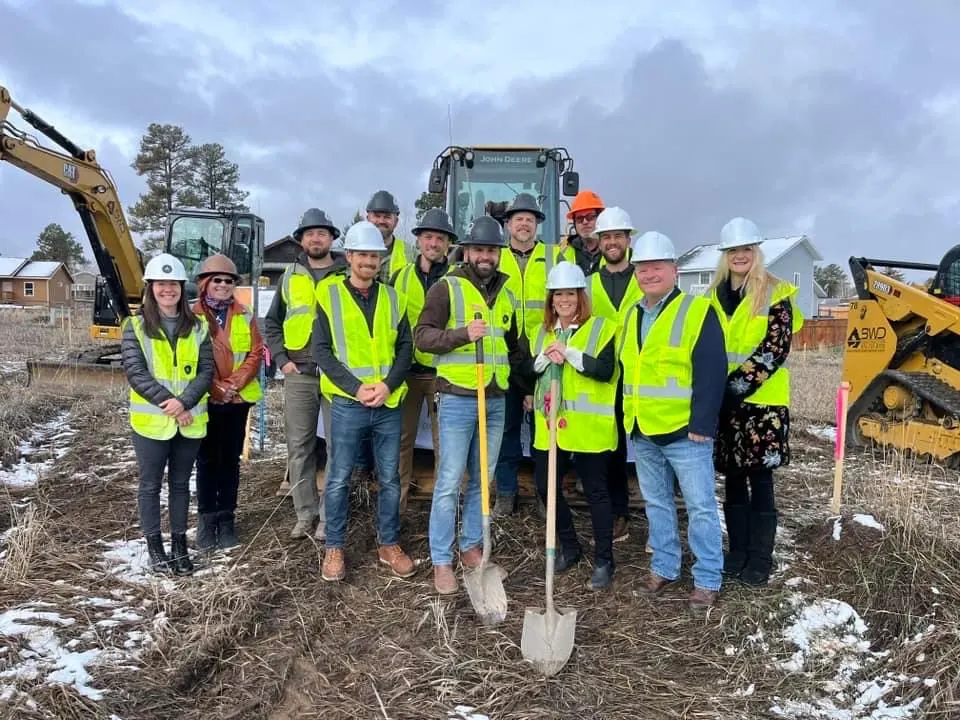
Tasked with identifying why attainable housing wasn't being built, PSCDC helped transform a decades-old failed development into 15 homes for local workers while creating the partnerships, infrastructure, and financing solutions needed for future housing.
In 2023, local leaders asked the Pagosa Springs Community Development Corporation (PSCDC) to help answer a difficult question: Why was it so hard to build affordable housing in Archuleta County?
Home prices had climbed beyond the reach of many working households. Teachers, emergency responders, healthcare workers, and other essential employees struggled to find housing they could afford. Employers faced growing challenges attracting and retaining the people their businesses and the community depended on.
What began as an effort to identify the barriers became something much larger: a locally driven workforce homeownership initiative that has delivered 15 homes, expanded essential infrastructure, and created a foundation for future development.
Finding opportunity in a failed development
Part of the solution emerged from the Chris Mountain II and Trails subdivisions, where a development had stalled more than two decades earlier.
The original developer never completed the promised infrastructure, leaving property owners with lots they could not reasonably develop. Over the years, unpaid property taxes, penalties, and fees accumulated, making the properties increasingly difficult to sell or recover economically.
Archuleta County began a legal process to recover the properties and offered the lots at auction. The auctions generated little interest, and the few bids fell far below the properties' assessed or anticipated value. With incomplete infrastructure and substantial outstanding tax obligations, the lots held little appeal for conventional development.
County leaders recognized an alternative opportunity: use the land to address the community's housing shortage.
Through collaboration with PSCDC and Habitat for Humanity of Archuleta County, the county ultimately transferred 35 lots to PSCDC and 10 to Habitat, establishing opportunities to serve working households at different income levels.
The land provided a starting point, but it did not solve the underlying problem. PSCDC still needed to find a way to build homes that local workers could afford.
Bringing the pieces together
PSCDC developed what it calls a Full Circle approach, assembling the partners, expertise, and financing necessary to make workforce homeownership possible.
The organization surveyed employees of major local employers to document housing demand, engaged builders to evaluate construction options and costs, and brought lenders into the process to identify financing options for both development and prospective homebuyers.
With a plan to build 35 homes, PSCDC also pursued funding to bridge the gap between construction costs and what eligible buyers could afford.
In 2024, PSCDC secured $550,000 through Colorado's Proposition 123 Homeownership Program for the first ten homes, providing $55,000 per home to help offset construction costs.
Following a competitive selection process, PSCDC partnered with local builder BWD Construction, whose relationships with area subcontractors and suppliers helped keep more of the investment within the community.
Investing beyond the homes
PSCDC and its partners quickly recognized that incomplete infrastructure presented an obstacle far beyond the initial construction sites.
Working with Archuleta County, the Town of Pagosa Springs, La Plata Electric Association, and other community partners, PSCDC pursued a broader solution through the Colorado Department of Local Affairs' More Housing Now program.
The coalition secured a $1.9 million infrastructure grant to extend electrical service, accommodate fiber connectivity, and improve roads throughout Chris Mountain II and Trails.
Rather than investing only in the initial workforce housing lots, the project addressed infrastructure gaps across the larger development. These improvements expanded development potential for more than 200 lots, opening opportunities for future housing and private investment.
The effort transformed a stalled subdivision into an area with significantly greater development potential.
Turning investment into homeownership
PSCDC completed its first ten single-family homes through Phase I and has since delivered five additional homes, bringing the total to 15 workforce homes.
Making those homes attainable required much more than construction. PSCDC coordinated eligibility requirements, lending, down payment assistance, and long-term deed restrictions designed to preserve affordability for future buyers.
State funding requirements, rising interest rates, and construction costs complicated the process. Working with lenders and housing partners, PSCDC continued finding ways to connect qualified workers and families with homeownership opportunities.
Among Phase I buyers were a teacher, a 911 operator, a utility worker, a construction worker, a fishing guide, and employees of local businesses. Families with children also gained opportunities to remain in the community they call home.
Phase I represented approximately $3.9 million in development activity, with an estimated 80% of spending remaining in Archuleta County through local labor, materials, and related work.
The project created housing opportunities while supporting local businesses, contractors, and the broader economy.
Building a foundation for what's next
The impact extends well beyond the 15 homes.
PSCDC and its partners developed a collaborative model that connects land, infrastructure, construction, financing, and homebuyer assistance. The work established relationships and processes that can support additional workforce housing and inform future development efforts.
The experience also exposed barriers within Colorado's Proposition 123 program. PSCDC and regional partners subsequently helped advance legislative changes to make homeownership funding more responsive to the realities of rural communities.
PSCDC was initially asked to identify why attainable housing wasn't being built. Through sustained collaboration, funding development, and implementation, the organization helped create the conditions to make it possible.