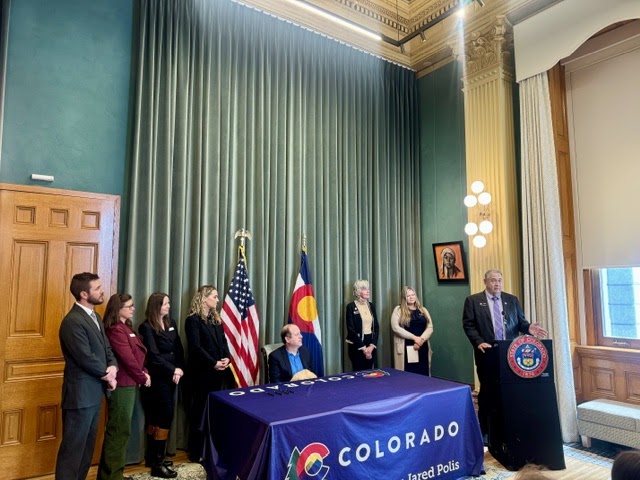
When state housing requirements prevented local workers from qualifying for attainable homes, PSCDC helped lead a bipartisan effort to change the law, creating more workable homeownership opportunities for rural communities across Colorado.
Imagine earning $200 too much to qualify for an affordable home while earning nowhere near enough to purchase a home at market prices.
That was the reality for working households in Archuleta County, where the Pagosa Springs Community Development Corporation (PSCDC) encountered an unexpected obstacle while developing the first workforce homes.
The challenge ultimately sparked something much bigger than a local housing solution. Working with elected officials, neighboring counties, housing advocates, and state partners, PSCDC helped advance legislation that addressed barriers within Colorado's Proposition 123 Affordable Home Ownership Program.
In May 2026, Governor Jared Polis signed Senate Bill 26-040, creating greater flexibility for communities working to expand attainable homeownership.
When the numbers didn't work
PSCDC entered the first round of Proposition 123 homeownership funding in 2024, securing $550,000 to help make the first ten workforce homes affordable.
The program helped offset construction costs, but its requirements created an unintended problem.
Under the funding rules governing PSCDC's project, homebuyers could not earn more than 100% of Area Median Income (AMI), regardless of how close they came to qualifying. At the same time, rising construction costs and mortgage interest rates made the homes increasingly difficult to afford within the program's limits on monthly housing costs.
PSCDC began encountering applicants who could afford the required payments but earned slightly too much to qualify. Others met the income requirements but could not afford the payments.
The organization documented the problem through actual homebuyer applications. By early 2026, approximately 100 people had applied for homes, and nearly 40 had encountered eligibility barriers because their annual incomes exceeded the limit by as little as $200 to $1,000.
The result was a frustrating contradiction: Archuleta County desperately needed workforce housing, PSCDC had built the homes, and qualified local workers still struggled to purchase them.
For a nonprofit committed to developing additional homes, the restrictions threatened the viability of future construction.
Taking a local challenge to the state
PSCDC Executive Director Emily Lashbrooke began working to address the problem beyond Archuleta County.
She brought the issue to Senator Cleave Simpson, Archuleta County Commissioner Warren Brown, and regional housing partners, explaining how the requirements affected real households and development costs.
The challenge wasn't unique to Pagosa Springs. Other rural communities faced similar conditions, particularly in markets where construction costs exceeded what local income levels could support.
Emily joined forces with Commissioner Brown, La Plata County Commissioner Matt Salka, and other partners to document those barriers and build support for legislative changes.
The effort expanded through conversations with the Gary Community Ventures team, including Zack Martinez, Colorado Counties, Inc., state housing organizations, local governments, financial institutions, and other stakeholders.
PSCDC used firsthand experience with construction costs, financing challenges, and restrictive eligibility requirements to demonstrate how state policies affected workforce housing development in rural communities.
As the coalition grew, communities across rural Colorado recognized the potential benefits of greater flexibility. The effort ultimately drew support from dozens of rural communities.
Building a bipartisan solution
Senator Cleave Simpson helped move the issue into the legislative process, working with Senator Judy Amabile and Representatives Katie Stewart and Lesley Smith as bipartisan prime sponsors of SB26-040.
The effort required substantial negotiation among legislators, state agencies, housing organizations, lenders, and other stakeholders with different perspectives on affordability requirements.
Emily, county commissioners, and project partners participated in discussions, presentations, and legislative testimony to explain how existing requirements affected rural housing development.
Their shared objective was not to eliminate affordability standards. It was to make those standards workable in communities where the relationship between incomes, construction costs, and home prices differs dramatically from larger urban markets.
On May 6, 2026, Governor Polis signed SB26-040 into law.
What changed for Colorado
The legislation introduced important changes to the Affordable Home Ownership Program.
The law raised the income limit for certain affordable homeownership projects from 100% to 120% of Area Median Income and clarified that programs may use either the applicable local or statewide AMI measure.
It also established a 38% maximum monthly housing-cost standard for qualifying projects, providing additional flexibility where earlier requirements prevented otherwise eligible households from purchasing homes.
The legislation created a waiver process for certain projects that struggle to sell completed homes, along with provisions allowing rental arrangements under state guidance.
These changes give housing organizations and communities more tools to respond to local market realities while maintaining the program's underlying goal of expanding affordable homeownership.
Local experience. Statewide impact.
The passage of SB26-040 represents a significant achievement for the many organizations and individuals who helped advance it.
For PSCDC, the effort began with a straightforward responsibility: deliver workforce housing that local residents could afford.
When state requirements created barriers, PSCDC documented the consequences, brought partners together, and helped pursue a solution beyond the local project.
A problem first confronted while building homes in Archuleta County helped drive policy changes with the potential to benefit housing development throughout Colorado.
The legislation demonstrates how local experience, regional collaboration, and bipartisan leadership can translate practical challenges into meaningful statewide change.